Showing posts with label nonfiction. Show all posts

Monday, February 8, 2021

Celebrating Black History Month

 February is Black History Month, and one of our library displays reflects several important events and people associated with that. 


Mike Rawls's website thebookwrangler.com has a fantastic resource for February's celebration of Black History Month, and I tailored it to reflect our own library collection here at the Middle School. Each day of the month highlights an event or person, and it also includes a related book for students to learn more or explore an interest. While many of the featured books are biographies and collected biographies, some stand-alone nonfiction titles are also part of the recommendations. See below for just a few of the people and events recognized:


And you can see the full month here:

Take a look if you're in the library, or stop by each day to see that day's specific person or event. Happy reading!

Thursday, March 5, 2020

Using Google Slides to Build an "App"

Recently seventh grade Literacy Studies students completed a long-term assignment that combined fiction books with nonfiction reading in our AEA databases. My colleagues Lacey Sedrel and Melissa White recommended that students use Google Slides to create what appears to be an app so students could show what they learned in an unusual way. Thanks to Gina Rodgers and and Amber Bridge, digital learning consultants from Grant Wood AEA, who shared their presentation "Google Slides: The Swiss Army Knife of Google Tools" at a fall technology conference session that Lacey and Melissa attended. It was the inspiration for students' work for this unit.

First, students used our Destiny catalog and Destiny Discover to identify nonfiction topics associated with a fiction book of their choice. Students also talked with one another about common books read to get feedback on nonfiction topics not listed as subject headings in the catalog. We also used our class read aloud Solo by Kwame Alexander as an example:
What we noticed was that several nonfiction topics we identified with the story weren't listed as subject headings, such as adoption, Ghana, guitars, and music. Ultimately, students would choose two nonfiction topics from their reading to become the basis of their research in our AEA databases.

Once fiction books and nonfiction topics were solidified, students worked in Slides to create their "apps." Along the way, students learned a few new tricks in Slides--namely, how to orient their Slides vertically and how to link Slides within the presentation to one another. The template from which they worked included five Slides:
  1. Front page
  2. Home screen
  3. Fiction book
  4. Nonfiction topic #1
  5. Nonfiction topic #2
Students' nonfiction topics became the focus of their work in our AEA databases. Students briefly worked with SUPERSearch, which allowed us to discuss how to narrow a search and search particular types of resources.
Students also returned to familiar databases like Britannica and CultureGrams to complete some of their work. 

Students turned in their work through Google Classroom, but we also shared our links with one another using Padlet. This allowed different classes to see their classmates' work and read about a variety of topics. 

Accessing one another's projects and viewing the work in presentation mode allowed students to move through Slides as though they really were using an app based on the fiction book. Below are some Slides from students' work:


Finally, students responded in a Google Form in a ticket out after looking at one another's projects and reading about several books and nonfiction topics.

Monday, February 24, 2020

Showing Some Love to Nonfiction Reading

Recently both sixth grade and seventh grade Literacy Studies students completed work that relied on them using our online databases to do a little nonfiction reading to gather information related to topics of their choice. Sixth graders completed the AEA online databases tic tac toe project (you can read about it HERE in an earlier post), and seventh graders created an "app" using Google Slides. (More to come in a future post!)

Both projects included accessing our AEA databases and doing some nonfiction reading. To reinforce this, a recent library display showed students that the realities of nonfiction topics often are reflected in the fiction books they more often gravitate toward. Take a look at some of the more popular nonfiction topics and their fiction counterparts.


Topics for the display included:
  • bullying 
  • natural disasters
  • disease
  • war spies
  • paranormal activity
  • immigration
  • Holocaust
  • Vietnam War
  • extreme sports
  • autism
  • mental health
  • animals

 Throughout the year, students watch book trailers in Literacy Studies class as part of our routine, and often nonfiction titles are included. Recently students watched these trailers:


Stay tuned! More books--including nonfiction reading--will be featured in an upcoming post. Happy reading!

Monday, October 14, 2013

Fiction Meets Reality in a New Display

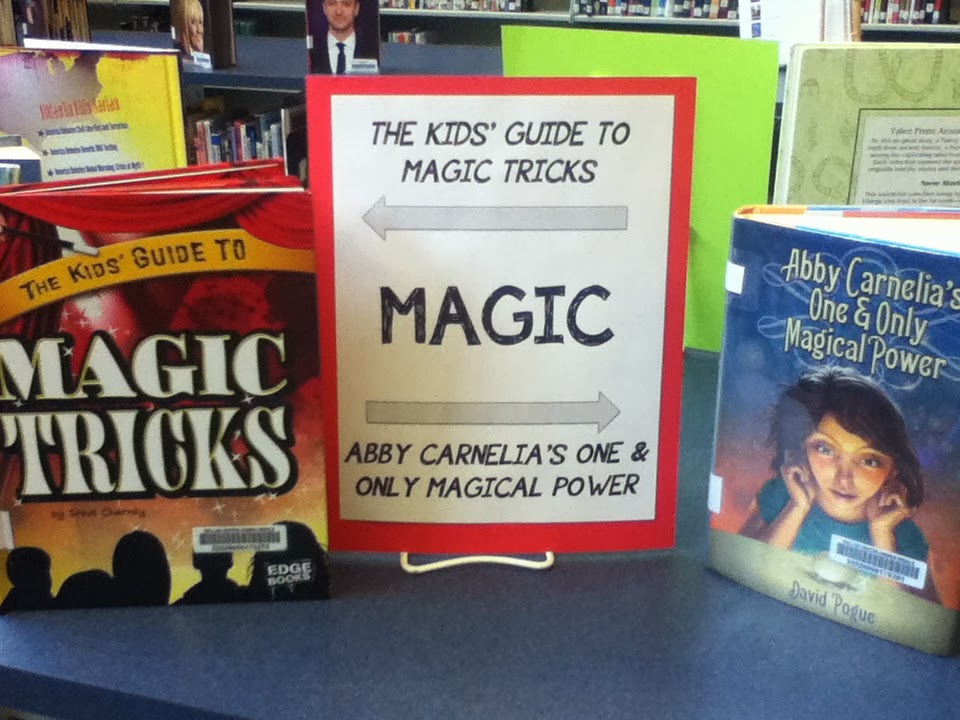
Naomi Bates from Northwest High School in Justin, Texas, had a great infographic in the newest issue of Library Media Connection. In it, she pairs a fiction book with a nonfiction book of a similar topic. Since statistics show that historically more fiction is checked out in our libraries than nonfiction, we decided to do something about it!

In all, 11 pairs of books are featured with topics including historical fiction (World War II and the Vietnam War), sports (Negro League Baseball), animals (shark attacks), and hobbies (magic). Below are some examples:


Feel free to stop by and browse the display--and soon all of the featured pairs will be available for check out!

Friday, January 13, 2012

Nonfiction EBooks

Through the AEA, teachers and students can access free, online nonfiction eBooks here. The books focus primarily on science and geography, and the collection includes biographies as well. The books are NOT downloadable. They are available 24/7 with unlimited/simultaneous use. No special ereader is required. Any portable device or computer with Internet access can be used, including iPads.

To access the ebook collection, you will need to use the same AEA online database username and password you use to sign in to EBSCO, CultureGrams, iClipArt, etc.